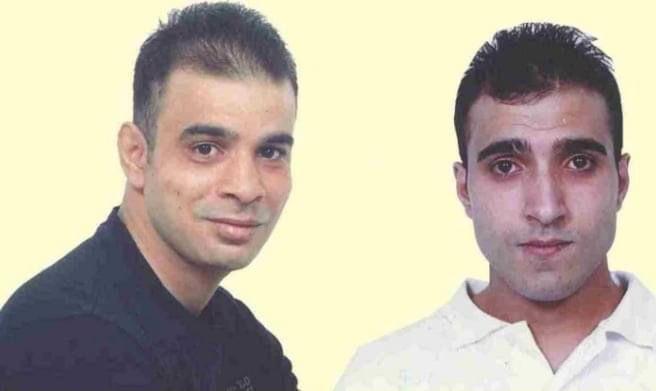
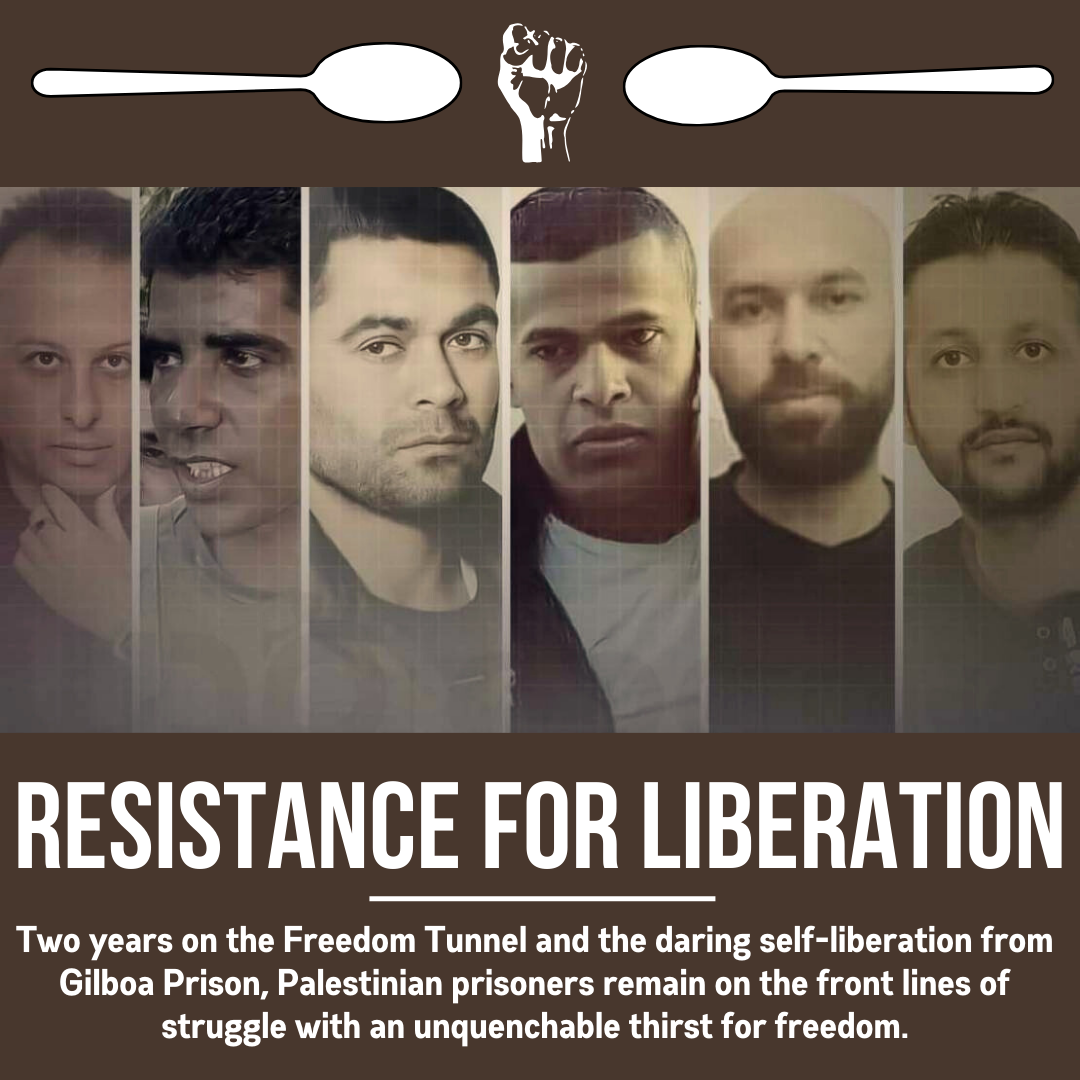
On the second anniversary of the Freedom Tunnel, in which six Palestinian prisoners: Mahmoud al-Ardah, Mohammed al-Ardah, Yousef Qadri, Ayham Kamamji, Munadil Nafa’at and Zakaria Zubaidi — liberated themselves from the Israeli occupation’s Gilboa prison, this iconic event continues to highlight the commitment of the Palestinian prisoners and the Palestinian people as a whole to strive towards and achieve liberation despite the most seemingly impossible circumstances. Samidoun Palestinian Prisoner Solidarity Network affirms that 6 September 2021 is now an anniversary of justice for the Palestinian people, the Arab nation and the international movement for justice and liberation.
This year, the anniversary of the Freedom Tunnel comes as the prisoners are preparing a battle to confront severe oppression and targeting at the hands of openly fascist Zionist minister of security, Itamar Ben Gvir. Most recently, Ben Gvir, on top of multiple other attacks on the prisoners, declared that the prisoners would be restricted to family visits once only every two months. This is in addition to the fact that family visits are frequently banned or denied due to “security” restrictions targeting the prisoners. Not only have the Palestinian prisoners’ movement and numerous international organizations spoken out against this latest assault, it has also put the contradictions of the Zionist regime on full display. Various Zionist officials, including prison administration director Katy Perry and intelligence officers, have declared that Ben Gvir’s order should not go through — not because they are concerned about the rights and humanity of Palestinian prisoners, but because they fear their resistance, noting that it will undermine “security” in the prisons and of the Zionist regime overall.
The Higher Emergency Committee of the Palestinian Prisoners’ Movement issued a statement commemorating the occasion:
In the name of God, the most gracious, the most merciful
To our great people, greetings of defiance, steadfastness and return…
We communicate with you today through this statement, and two years have passed since an event changed the course of national struggle within the prisons, an event that reminded the world, and its free and honourable people, that freedom is a necessity and striving for it by all means is an obligation of our time, after six of our prisoners were able to wrest their freedom – albeit temporarily – from the prisons of the Zionist occupation, despite all the security mechanisms of the enemy, declaring the victory of free will over tyranny and deception.
Then the enemy decided, through its agents represented by the prison administration, to try to impose penalties and measures against all the prisoners to break their will for freedom, so it was necessary for the captive national movement to unite and overcome every disagreement and division to confront this challenge. It was – with the grace of God – up to this challenge, and succeeded in repelling this aggression. At that time the Higher National Emergency Committee was formed to manage the crisis with competence, unity of action and decision-making, and after that has fought more than 6 rounds of challenges and battles with the occupier, and has succeeded each time in strengthening unity and victory.
Today, two years after this event, which represents victory, unity, and the quest for freedom, and as the challenges recur and the rounds of struggle continue, and as the meaning of unity has become entrenched in the ranks of all prisoners from all of the national and Islamic forces and factions, this comittee has proven its unity through action, a unity that has never been and will not be simply a matter of emergency. Therefore, from this position, we announce our adoption, starting on this honourable day in the history of the prisoners’ movement, that our official name as the united force of the prisoners’ movement is the Higher National Committee for the Prisoners’ Movement.
This announcement and this occasion come as we are confronting a new criminal attack by our enemy in its attempts to reduce visits to once every two months while threatening other measures to affect our lives and existence in detention. Therefore, our decision is to announce a hunger strike next Thursday, 14 September 2023, unless the enemy backs down and commit not to undermine our rights that we have taken with our blood, our flesh and our torture.
To our great people, the renewed unity in the dungeons of imprisonment, among the heirs of the martyrs, must be embodied in practice in all arenas and institutions of the Palestinian national liberation struggle. Your support for us is the key to our victory, God willing, so be, as we have always promised to you, our strong pillar and our impenetrable fortress.
The Higher National Committee for the Palestinian Prisoners’ Movement
6 September 2023
On this occasion, we are republishing our analysis (slightly edited) issued on the first anniversary of the Freedom Tunnel, below. As we commemorate this liberatory anniversary, we urge all to organize to liberate the Palestinian prisoners currently hunger striking for freedom, to join with the Palestinian prisoners’ movement in its next great battle against repression, and to join us on Saturday, 21 October in Lannemezan, France to march for the liberation of Georges Ibrahim Abdallah (Lebanese struggler for Palestine jailed in France for 39 years), all Palestinian prisoners, and the liberation of Palestine from the river to the sea.
The Freedom Tunnel: Palestinian prisoners leading the resistance
- Historic Palestinian prisoner escapes
- Inside prisons: confronting the occupier
- The Freedom Tunnel and the resistance
- Internationalism and the Freedom Tunnel
- The Freedom Tunnel Prisoners
- Samidoun statements on the Freedom Tunnel
Today, 6 September, marks the anniversary of the Freedom Tunnel, when six Palestinian prisoners liberated themselves in 2021 from the high-security Gilboa prison of the Israeli occupation. The six Palestinians — Mahmoud al-Ardah, Mohammed al-Ardah, Yousef Qadri, Ayham Kamamji, Munadil Nafa’at and Zakaria Zubaidi — became national and international symbols of resistance and of the Palestinian will to freedom in seemingly impossible circumstances, while the simple spoon became a new icon of the resistance and steadfastness of the Palestinian people and their resistance leaders behind bars. While the six were eventually re-captured, their daring, well-organized escape from Gilboa exposed the weakness and cracks hiding beneath the propaganda exterior of “impenetrable Israeli security,” throwing the occupation prison system into internal crisis.
Five more Palestinian prisoners — Iyad Jaradat, Mahmoud Abu Shreim, Ali Abu Bakr, Mohammed Abu Bakr and Qusay Mar’i — are also imprisoned for their role in supporting the Freedom Tunnel actions. The six Freedom Tunnel prisoners and the five who supported them are held in solitary confinement and isolation, in a fruitless attempt to prevent their actions from remaining a bright example to the Palestinian prisoners’ movement and the Palestinian people.
Coming as it did so soon after the battle of Seif al-Quds/the Unity Intifada, the Freedom Tunnel captured the imaginations and consciences of the Palestinian people and Arab nation but also of all around the world who struggle for justice and liberation. Despite decades spent behind bars, the occupation was unable to break the will of the Palestinian prisoners or their leadership in resistance, and the six heroes of the Freedom Tunnel have once again demonstrated this clearly to the world.
Following the Freedom Tunnel, the occupation imposed a new series of repressive measures targeting Palestinian prisoners, many of which have once again been defeated through the action and resistance of the prisoners’ movement.
Palestinian Prisoner Escapes
The Freedom Tunnel built on a long history of Palestinian prisoners’ resistance actions, from hunger strikes to collective rebellions behind bars, as well as successful escapes and self-liberations from occupation prisons. Some of the major escapes in Palestinian history include:
- Atlit prison, 1938 – One of the leaders of the 1936-1939 revolt in Palestine against British colonialism, who fought alongside Sheikh Izzedine al-Qassam, Issa Hajj Suleiman al-Battat, escaped with several other Palestinian prisoners jailed by the British in 1938 before
- Shata prison, 1958 – Many estimate this was the largest prison uprising and escape since the Nakba. Approximately 190 Palestinian and Arab prisoners revolted inside the Shata prison in the Jordan Valley on 31 July 1958. 77 prisoners escaped after fierce fighting in which 11 prisoners and two jailers were killed.
- Hamza Younes prison escapes, 1964, 1967 and 1971 – Palestinian prisoner Hamza Younes, from Ara, south of Haifa, escaped from occupation prisons on three occasions: from Asqelan prison, from a hospital and a third time from Ramle prison. In 1971, he escaped to Lebanon where he joined the Palestinian resistance there.
- Ramallah prison, 1969 – Mahmoud Abdullah Hammad from Silwad, near Ramallah, escaped during a prisoner transfer in 1969. He evaded occupation forces for nine months and successfully made it to Jordan.
- Nasser Issa Hamed and Majdi Suleiman Abu al-Safa, 1983 – Nasser was 15 years old at the time and was taken to the occupation court on 27 January 1983. The prisoners launched a confrontation inside the court and Nasser escaped into Ramallah, where he took shelter in an unfinished construction project. He hid in a well as he attempted to make his way home to Silwad, but eventually turned himself in after his mother was arrested by the occupation forces. One month later, learning of the story, Majdi Suleiman Abu al-Safa escaped in the same way from the occupation courts, making his way to Jordan and then to Colombia and Brazil, where he has remained until the present day.
- Gaza prison, 1987 – Six Palestinian prisoners escaped Gaza prison on 17 May 1987; three were later assassinated by occupation forces and one more was re-imprisoned. Imad Saftawi and Khaled Saleh fled the Gaza Strip and maintained their freedom.
- Nafha prison, 1987 – Three Palestinian prisoners, Khaled al-Rai, Shawqi Abu Nasir and Kamal Abdel-Nabi escaped Nafha prison successfully in 1987 but were recaptured eight days later as they attempted to make their way to Egypt.
- Omar Nayef Zayed’s prison escape, 1990 – On 21 May 1990, Omar Nayef Zayed escaped from occupation prisons four years after his arrest as he was transferred to a hospital in Bethlehem. He made his way to Jordan and then to Bulgaria in 1994. In 2016, occupation forces attempted to have him extradited from Bulgaria to occupied Palestine, and he took refuge inside the Palestinian Authority embassy where he was later killed on 26 February 2016. His fight against extradition sparked an international campaign to support him and demand his freedom.
- Escape of Saleh Tahaineh, 1996 – Saleh Tahaineh escaped from Ofer prison in a complicated plan involving his fellow struggler Nu’man Tahaineh — later also assassinated by the occupation — and another Palestinian prisoner scheduled to be released. He took the place of the prisoner whose release was scheduled, who then noted that he had not been released. He had earlier switched places with Nu’man, who had a much lower sentence. He was pursued and eventually killed by occupation forces after being captured. Both Saleh and Nu’man Tahaineh were mentors of Mahmoud and Mohammed al-Ardah.
- Kfar Yona prison, 1996 – Two Palestinian prisoners, Ghassan Mahdawi and Tawfiq al-Zaben, escaped through a tunnel in 1996, the first prisoner escape that made use of a tunnel. While Mahdawi was seized the next year, al-Zaben was pursued by the occupiers for four more years.
- Ofer prison, 2003 – Four Palestinian prisoners escaped from Ofer prison in 2002 during the Al-Aqsa Intifada, including Palestinian student Amjad al-Deek, using spoons and other implements to tunnel their way outside the prison. Three were later recaptured while Riyad Khalifa was killed by occupation forces.
- Freedom Tunnel, 2021 – Six Palestinian prisoners escaped from Gilboa prison after digging a tunnel beneath the prison. While they were eventually recaptured, their bravery and commitment inspired Palestinians, Arabs and people around the world, especially in an era of advanced technological surveillance.
- Multiple escape attempts – Over the years, Palestinian prisoners, including Mahmoud al-Ardah, who led the Freedom Tunnel operation, attempted to escape, including digging lengthy tunnels before being blocked. These included prisoners in Shata prison in 1998, Asqelan prison in 1996, Gilboa prison in 2014, and Eshel prison.
Inside the Prisons: Confronting the Occupier
The Freedom Tunnel action not only captured the imagination of Palestinians, Arabs and internationals seeking justice, in an era in which such actions had come to seem nearly impossible due to the high level of technological and electronic surveillance, it also sparked a crisis for the occupation. It exposed the weaknesses and failures in the system of military occupation that could not be protected by technology alone and remained highly vulnerable to the human element of the drive for freedom.
Since the Freedom Tunnel, the occupation has deployed large sums of money and resources to “enhance security” in the prisons, especially as they completed their self-liberation from Gilboa Prison Section 5, which had been constructed in 2004 and was touted as “invulnerable” to escape attempts. Over a period of time, the six prisoners dug the tunnel to the outside below the toilet area. They proceeded through the tunnel at approximately 1:49 am, and they were discovered not by an alert within the prison but by a settler who reported the presence of a “suspicious person” nearby. Images of occupation soldiers staring at the hole in the ground left by the tunnel and puzzling over the prisoners’ route were widely distributed.
The prison administration immediately began to implement measures against the prisoners following their public security humiliation. When the six heroes of the Freedom Tunnel were re-arrested, they were thrown in solitary confinement in difficult conditions, not provided medical care for their obvious injuries from beating and torture upon arrest, and transferred from prison to prison. However, they were not alone; the prisoners’ movement inside the prisons rose up, taking protest actions and burning cells to demand the rights of the Freedom Tunnel heroes. Outside, the Palestinian resistance announced that the six Freedom Tunnel prisoners would be at the top of the list for any upcoming prisoner exchange agreement.
Prison officials imposed a lockdown on many prisoners, particularly those of the Islamic Jihad movement and all prisoners with high or life sentences. Five of the six Freedom Tunnel prisoners are part of the Palestinian Islamic Jihad movement, while the sixth, Zakaria al-Zubaidi, is a longtime Fateh leader; all six are from Jenin. The occupation authorities attempted to impose transfers every six months on those with high sentences, engaged in mass transfers of the Islamic Jihad prisoners, blocked family visits and engaged in ongoing raids, invasions and aggressive searches throughout the prisons.
In March 2022, the united Palestinian prisoners’ movement escalated toward a collective open hunger strike to stop such measures from going into effect, and the occupation was forced to back down. When it attempted to do the same again in August 2022, the prisoners’ movement again planned for an open hunger strike to begin on 1 September 2022, which was again averted as the occupation backed down. Further, the Islamic Jihad prisoners also achieved an end to the ongoing transfers of their prisoners and to return the prisoners to the sections from which they were originally transferred, while two prisoners, Abdullah al-Ardah and Abed Obaid, were returned to the general prison population from isolation.
In May 2022, the six heroes of the Freedom Tunnel were sentenced to five additional years of imprisonment, while five more Palestinians — Mohammed Abu Bakr, Iyad Jaradat, Ali Abu Bakr, Mahmoud Abu Shreim and Qusai Mar’i — were sentenced to four years for assisting their fellow prisoners.
In response to the sentences, Yaqoub Qadri affirmed: “We do not care what the sentence is. The important thing is that we made the impossible possible; we were able to break through the Israeli security services and dealt a blow. We were able to achieve something that was unthinkable for Israel and its security mechanisms.”
Even the judge in the court essentially affirmed Qadri’s comments that the sentence is a form of revenge for exposing the fragility of colonial domination in Palestine, noting that their self-liberation, “paralyzed the nation for days” and caused large financial expenditures, imposing additional costs on the occupation.
The response to repression following the Freedom Tunnel has been increased resistance inside the prisons, strong unity between all Palestinian political forces and a continued promise of freedom that no amount of repression has been able to suppress.
The Freedom Tunnel and The Resistance
Estimates indicate that the occupation spent tens of millions of dollars in less than 12 days in their pursuit of the Freedom Tunnel heroes. They further launched a project to fortify the prisons at a cost of $2.5 million. Thousands of police and army forces participated in the searches, with 720 police patrols, dozens of military vehicles and 250 checkpoints set up in the panicked reaction to the self-liberation of these Palestinian prisoners.
The effect of this action on the occupier and the self-liberation of these six Palestinians from Jenin has continued to inspire and inflame the growing resistance in Jenin, which has been the site of harsh battles as occupation forces attempt to suppress the resistance. Many referred to the Freedom Tunnel heroes as the Jenin Brigade, the name taken up by the fighters resisting the occupation in Jenin and heroically fighting back a massive invasion in July 2023.
The Freedom Tunnel came only months after the Seif al-Quds Battle/Unity Intifada throughout Palestine and served to confirm once again that the prisoners are at the heart of the resistance and are a truly unifying factor for the Palestinian people and the Palestinian cause. The Palestinian resistance upheld the centrality of the prisoners in the defense of Gaza in the Unity of the Fields battle of August 2022 and again in the Revenge of The Free of May 2023, amidst massacres by the occupation and through the placement of the Freedom Tunnel prisoners at the top of the list for an exchange agreement.
Internationalism and the Freedom Tunnel
The message of the Freedom Tunnel was not confined to occupied Palestine nor even to Palestinians in exile and diaspora around the world. In protests and demonstrations in many international cities, the symbol of the spoon and the images of the Freedom Tunnel heroes inspired people to take to the streets to demand justice and liberation for Palestine and the Palestinian prisoners and an end to Western imperialist complicity with and support for occupation crimes.
From the Philippines to Colombia to France, where Georges Abdallah has been jailed for 39 years, the message of the Freedom Tunnel resonated among political prisoners and those fighting for their liberation. It proved the indomitable will of revolutionary prisoners and of the Palestinian people in seeking freedom in the most unfavorable circumstances, inspiring many to mobilize and join the movement to liberate Palestinian prisoners — and Palestine itself, from the river to the sea.
The Freedom Tunnel and the six heroes of the self-liberation operation represent the irrepressible hope of freedom and commitment to liberation that no amount of militarized repression and Zionist colonization has suppressed, for over 75 years. The actions of this “Freedom Brigade” are not only a symbol of hope for Palestinians but also for everyone in the world who seeks justice and freedom.
Building on the experiences of Palestinian prisoners who liberated themselves in the past, they exposed the crumbling edifices of the Israeli occupation and forced them to waste tens of millions of dollars in their massive manhunt. Their bravery and commitment to freedom is celebrated throughout Palestine, from the river to the sea, and everywhere around the world. Spoons – symbols of the rusty kitchen tools they used to dig their way to liberation – have come to represent the irrepressible drive to freedom.
Samidoun Palestinian Prisoner Solidarity Network urges all to build on the example of the Freedom Tunnel to stand with the Palestinian prisoners’ movement and the Palestinian people to demand justice and liberation for Palestine, from the river to the sea. We urge all to join us on 21 October in Lannemezan, marching for the liberation of Palestinian prisoners as a key demand and central core of the Palestinian struggle.
The Freedom Tunnel prisoners
Mahmoud al-Ardah
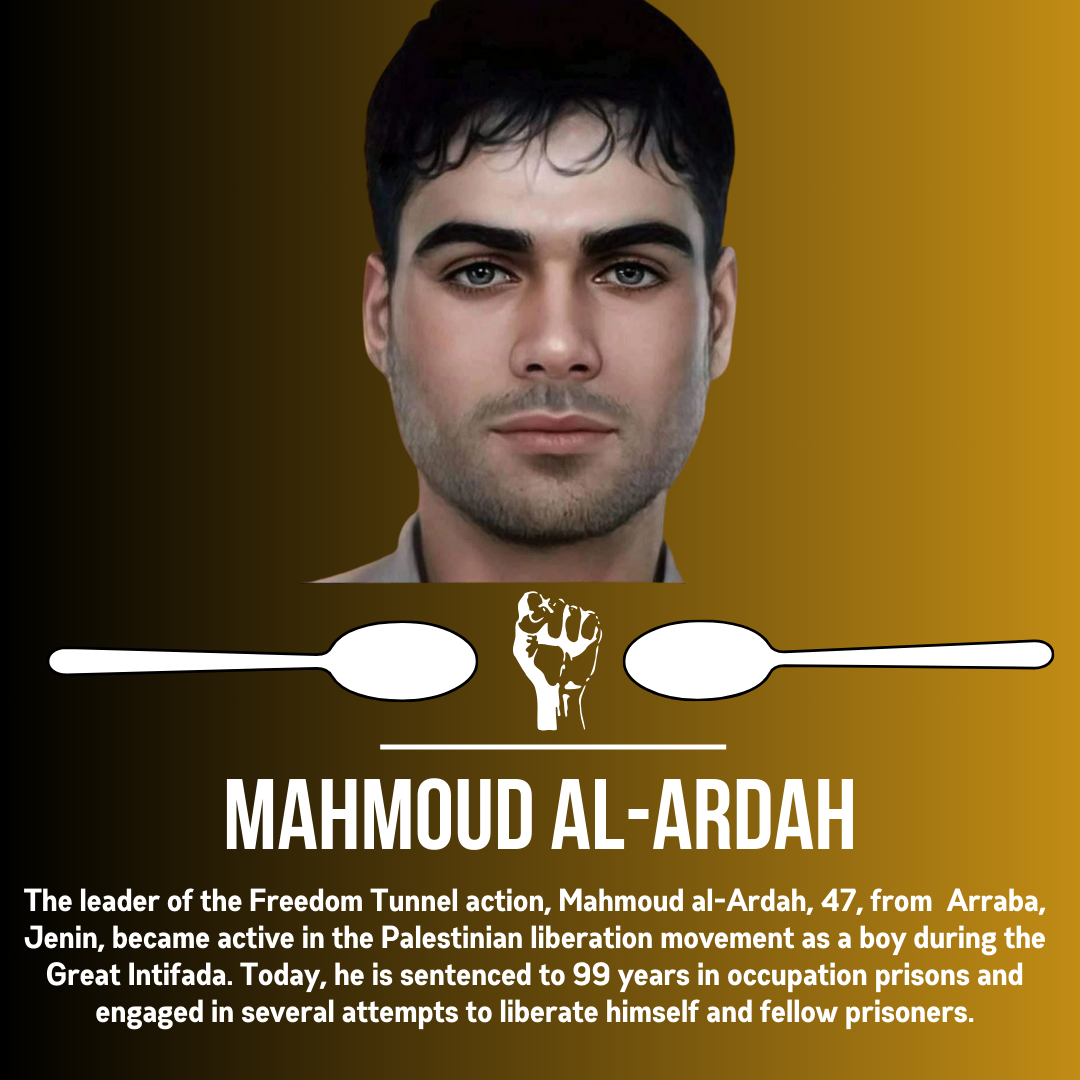
Mahmoud Abdullah al-Ardah, the leader of the Freedom Tunnel escape, was born on 8 November 1975 and grew up in Arraba, Jenin. He first became active as a boy during the great popular intifada of 1987 and was seized and imprisoned for the first time in 1992 on allegations of targeting occupation jeeps and military patrols with Molotov cocktails. He became a part of the Palestinian Islamic Jihad movement in prison before his release in 1996. Eight months later he was arrested again by the occupation forces for shooting a military officer invading Salfit and harbouring the martyr leader Saleh Tahaineh, who had himself escaped from occupation prisons. He was already sentenced to 99 years in occupation prisons before the Freedom Tunnel operation.
After his imprisonment, he attempted to escape on multiple occasions, in 2001, 2011 and 2014. In the latter instance, he was accused of digging a tunnel to escape from Shata prison and on each occasion he was placed in isolation. He obtained both his high school diploma and bachelor’s degree in prison and became a leader of the prisoners’ movement before designing and planning the Freedom Tunnel self-liberation.
Mohammed al-Ardah
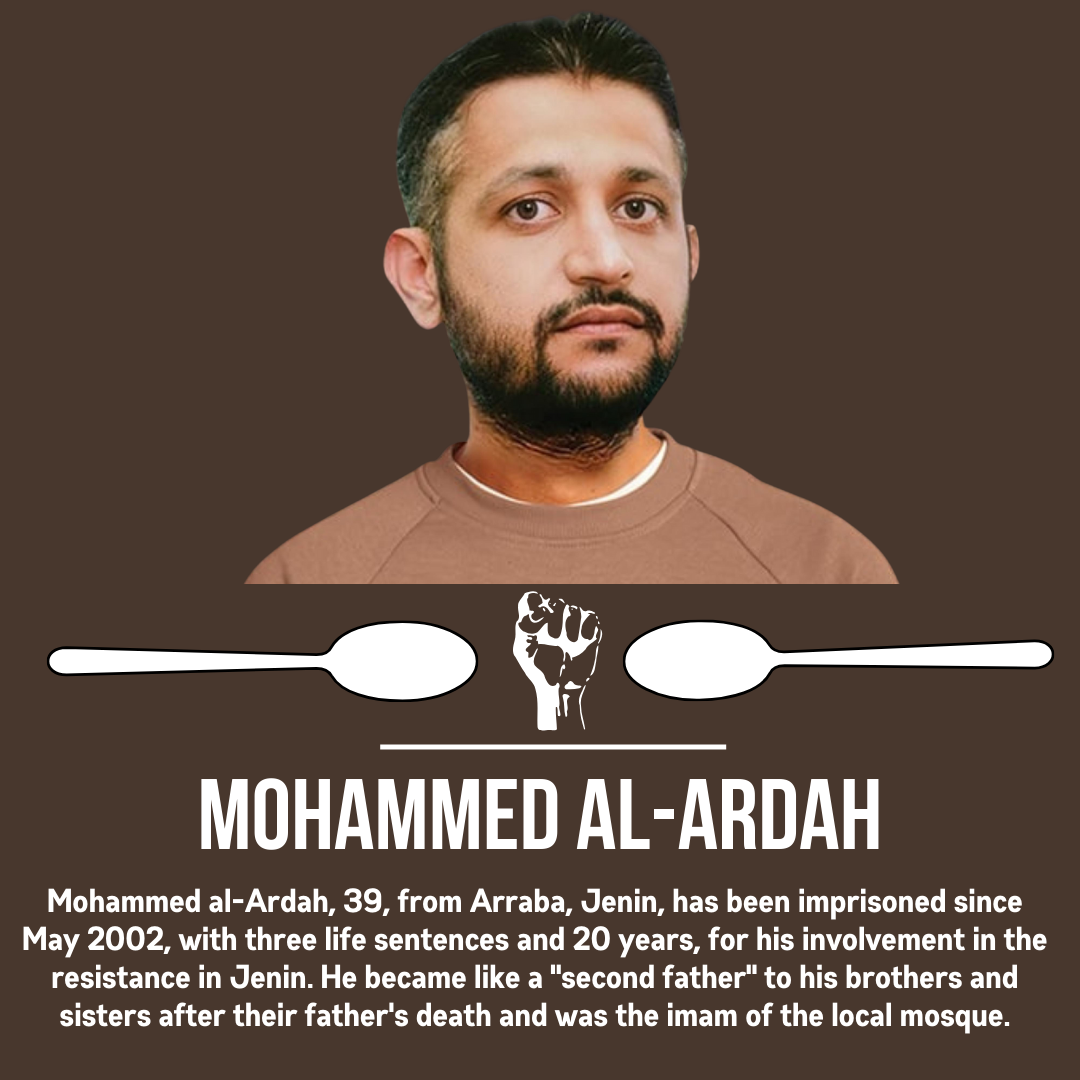
Mohammed Qasem al-Ardah, is 39 years old, from Arraba, Jenin. He has been imprisoned since 14 May 2002 and is sentenced to 3 life sentences and 20 years (now 25 years) in occupation prisons for his role in the military resistance to occupation, particularly during the Al-Aqsa Intifada. He is a struggler with the Palestinian Islamic Jihad movement. His brother, Ahmad, said that Mohammed was like a second father to their family after the death of their own father. He became the imam of the mosque in the area and a beloved, respected figure in Arraba. Like Mahmoud al-Ardah, Mohammed al-Ardah knew Nu’man Tahaineh, involved with Saleh Tahaineh in his escape, closely, as well as fellow escapees Iyad Sawalha and Iyad al-Hamran, both of which were involved in the 2002 escape from Ofer prison.
Yaqoub Qadri
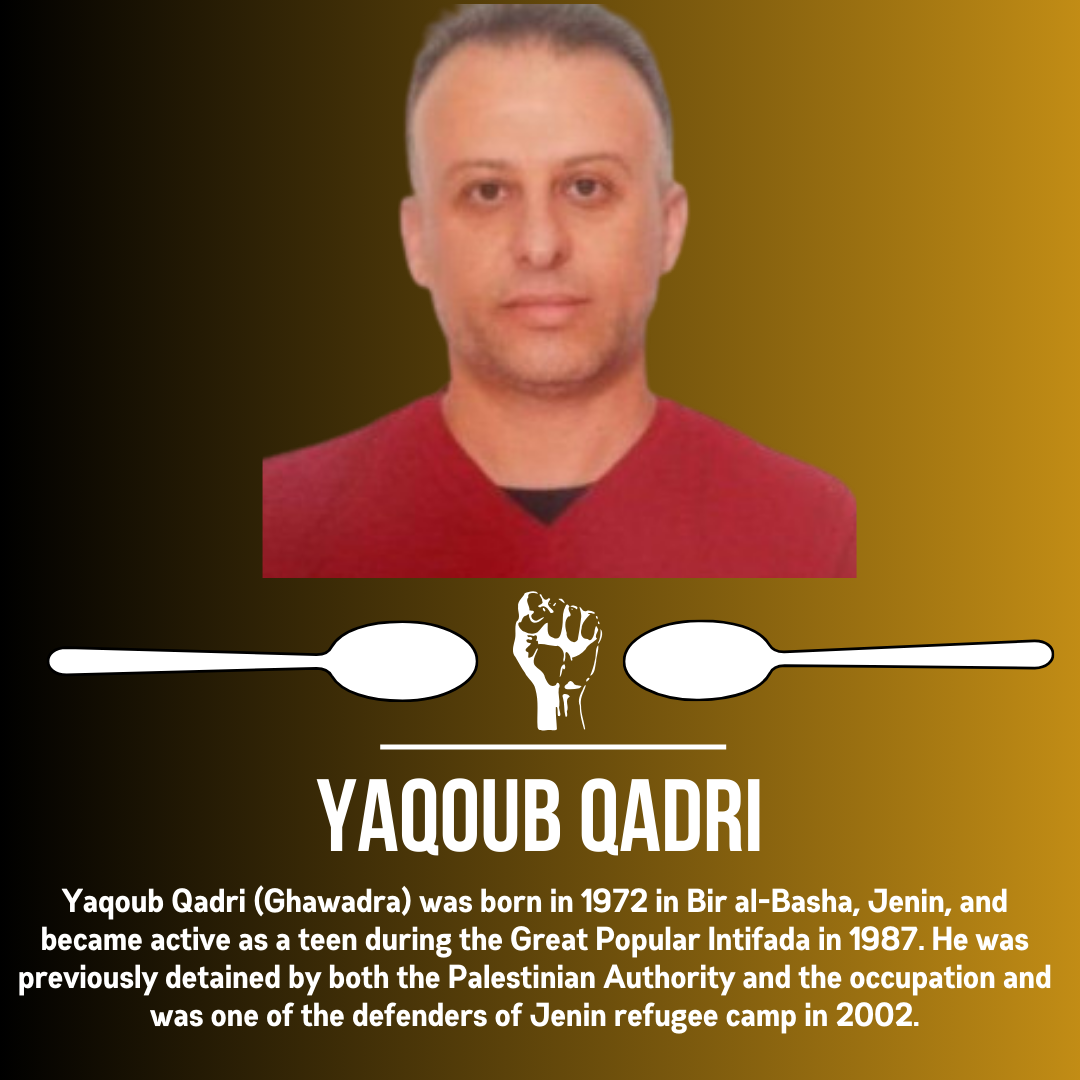
Yaqoub Mahmoud Qadri (Ghawadra) was born on 22 December 1972 in Bir al-Basha, Jenin, growing up in Bir al-Basha and neighboring Arraba. As a teen, he was active in the great popular intifada of 1987. Seized by the occupation forces, he became more active following his imprisonment. He was later detained by the Palestinian Authority in 1996 under its “security coordination” with the Israeli occupation, and with the Al-Aqsa Intifada, became active in the resistance with the Palestinian Islamic Jihad Movement, fighting to defend his village and neighboring villages and refugee camps from invasions by occupation soldiers.
He participated in the battle to defend Jenin camp in 2002 when it was subjected to massacres by occupation forces, and in operations targeting illegal settlers stealing Palestinian land. He was “wanted” and pursued by the occupation for over a year before he was seized in October 2003 in a cave near Zababdeh. He was sentenced to two life sentences and 35 years after spending four months under severe torture in interrogation in Jalameh interrogation center. He joined Mahmoud al-Ardah in the attempt to escape Shata prison in 2014 before once again joining in the Freedom Tunnel escape. He described the days of his self-liberation as the most beautiful of his life.
Munadil Nafa’at
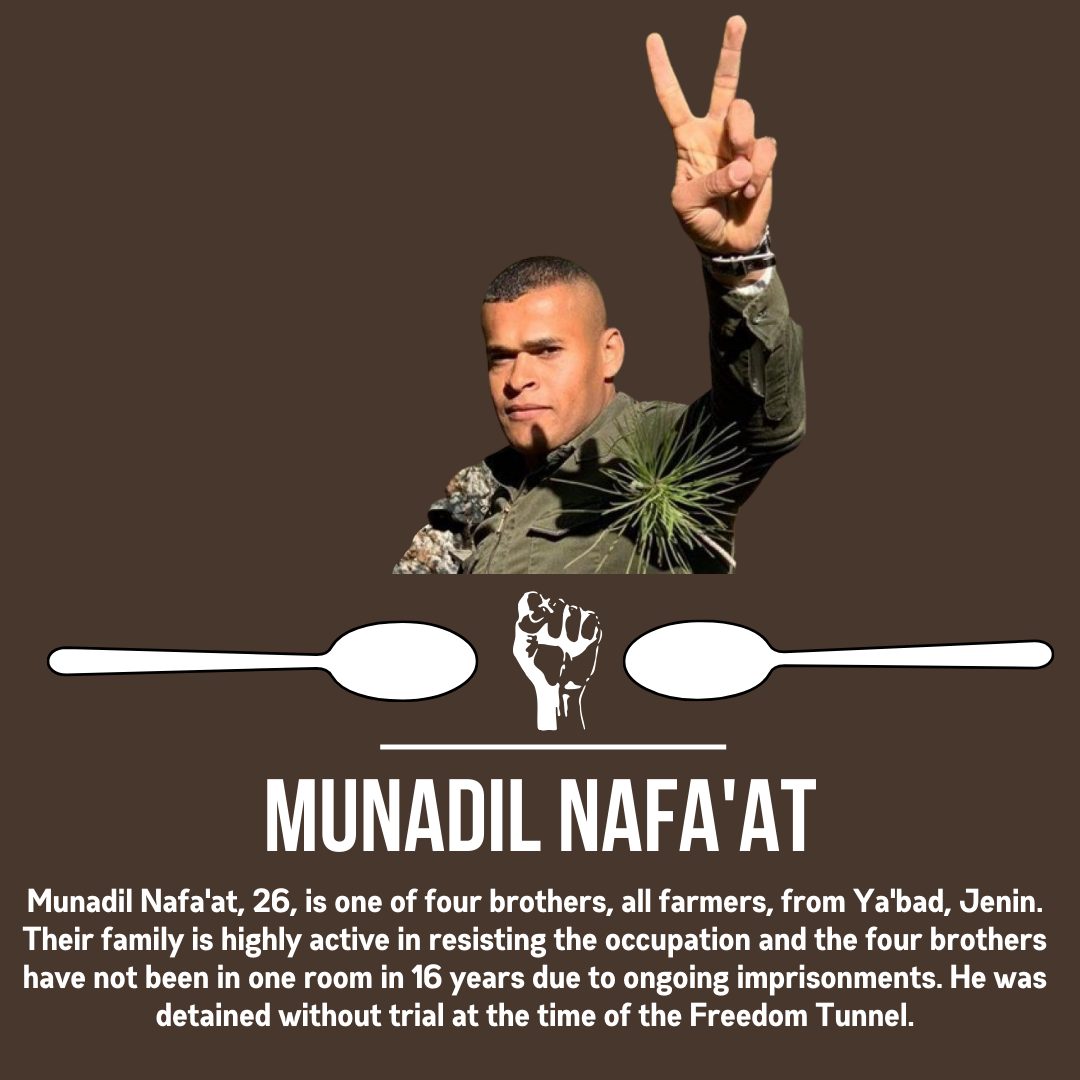
Munadil Naf’at, 26, is one of four brothers from Ya’bad, Jenin. His family is heavily involved in the struggle for Palestine, and the four brothers have not been able to meet in one room for 16 years, as one has always been imprisoned. He and his family are farmers; he has been arrested repeatedly since he was 14 years old. He had been detained for 19 months without trial on allegations of involvement with the resistance and the Palestinian Islamic Jihad Movement at the time of his self-liberation through the Freedom Tunnel.
Ayham Kamamji
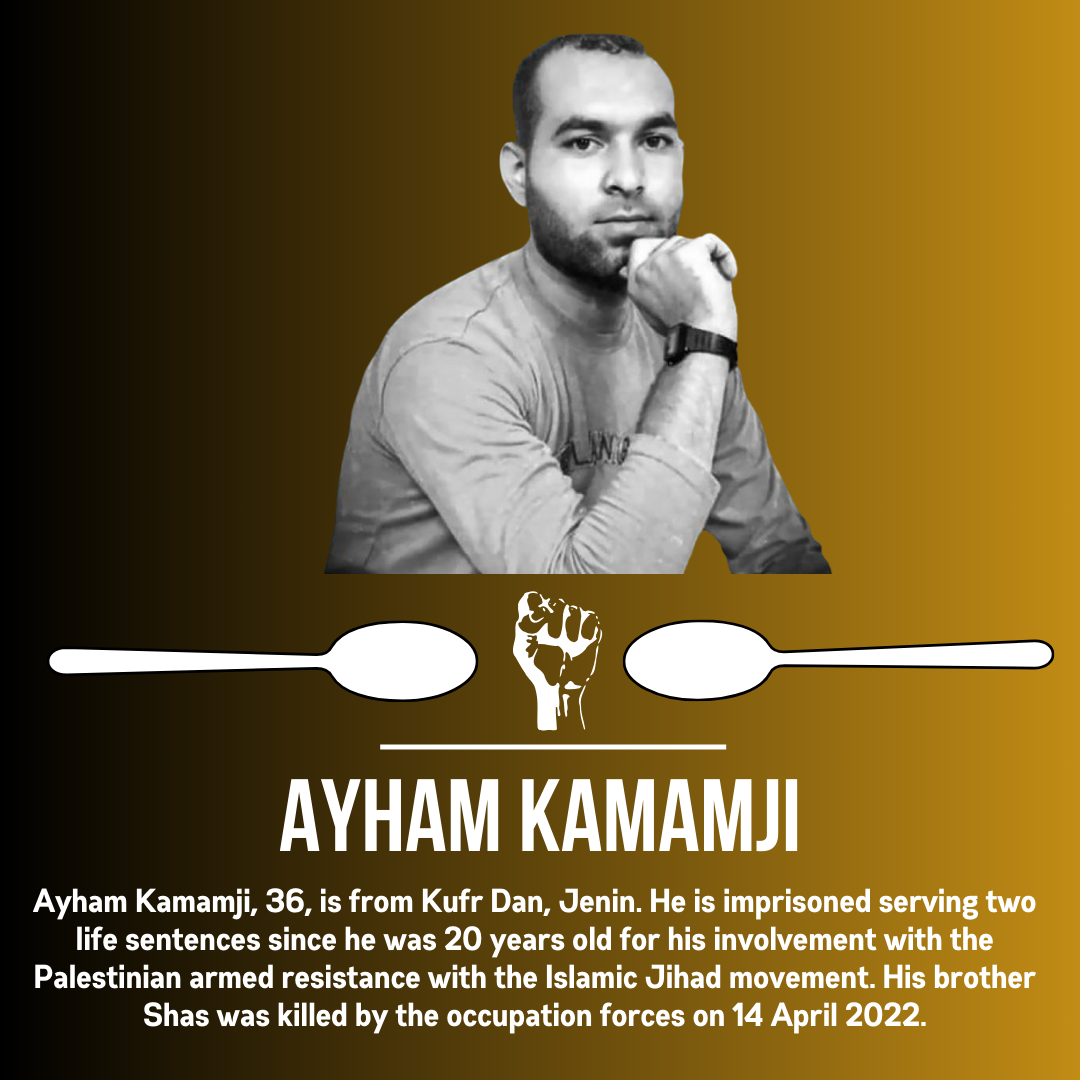
Ayham Fouad Kamamji, 36 years old, is from Kufr Dan, Jenin. He has been imprisoned since he was 20 years old in 2006 on the basis of involvement in the resistance with the Palestinian Islamic Jihad movement. Sentenced to two life sentences, he said that the inspiration for his escape was to see his mother’s grave, as he had been denied permission to attend her funeral in 2019. He had been active in the Palestinian prisoners’ movement since his arrest. On 14 April 2022, again only weeks before the additional sentencing of the Freedom Tunnel prisoners, his brother Shas Kamamji was killed by the occupation forces in Kfar Din. Many of Ayham’s brothers are also former prisoners for their role in resisting occupation.
Zakaria Zubaidi
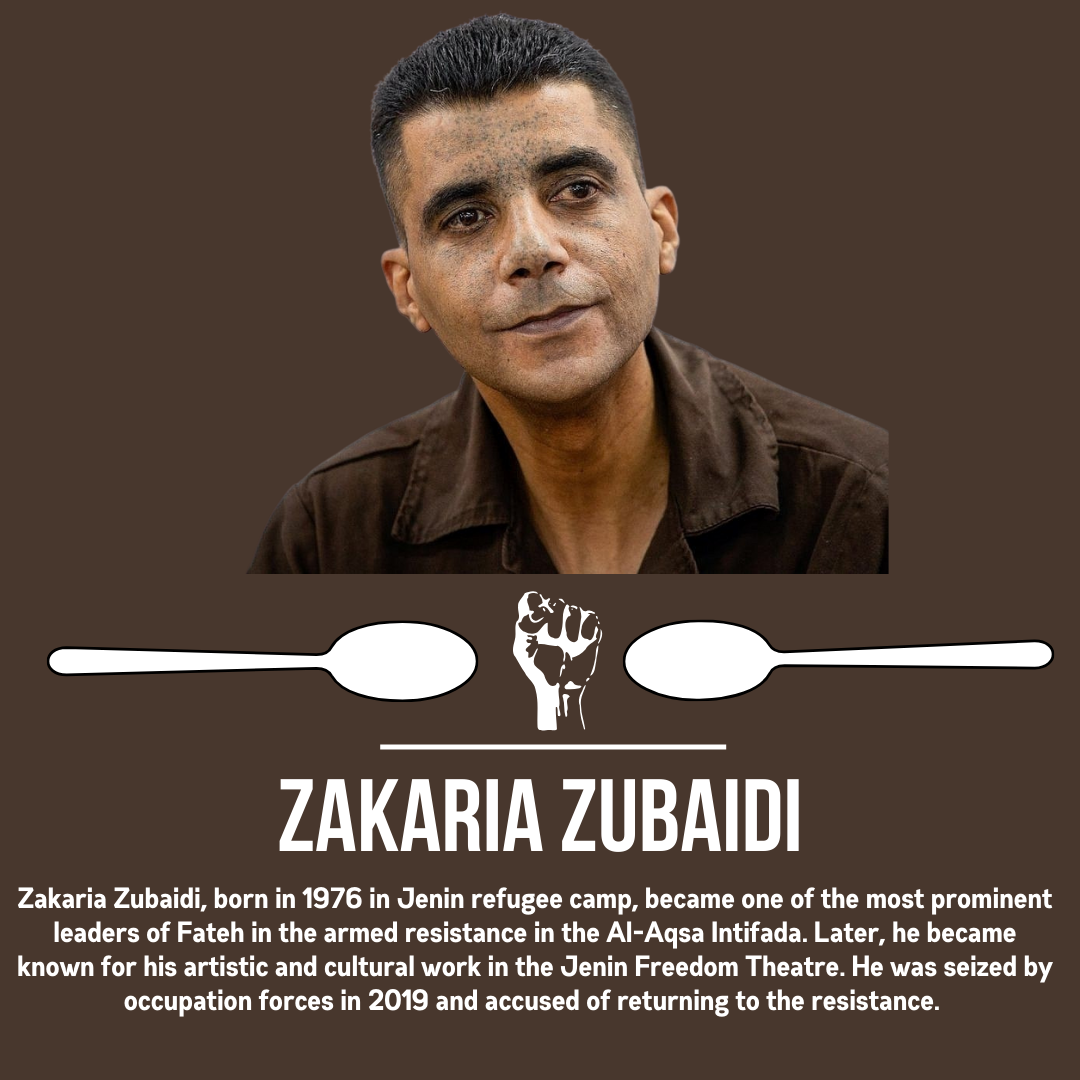
Zakaria al-Zubaidi, born in 1976 in Jenin refugee camp, became one of the most prominent leaders of Fateh’s armed wing, the Al-Aqsa Martyrs’ Brigades, during the Al-Aqsa Intifada. Both his mother and his brother were killed by occupation forces in 2002. He was repeatedly pursued by the occupation and was eventually promised an amnesty brokered by the Palestinian Authority. He married and had two children, a son and a daughter, and became a prominent advocate for Palestinian arts with the Freedom Theatre in Jenin. In this capacity, he met with many international activists and supporters of Palestine. His amnesty was revoked in 2011 and he was detained without charge by the Palestinian Authority for six months and then later held in a PA jail in “protective custody.” In 2018, he began his master’s degree studies at Bir Zeit University, but in 2019, he and his lawyer, Tariq Barghout, were seized by occupation forces and detained on allegations of armed resistance to the occupation. He finally obtained his master’s degree behind prison bars.
In May 2022, shortly before he was re-sentenced, occupation forces killed Daoud al-Zubaidi, Zakaria Zubaidi’s brother, a former Palestinian prisoner and a longtime struggler of the Palestinian resistance in Jenin.
Samidoun statements on the Freedom Tunnel
- “Freedom Tunnel” heroes sentenced to additional five years in occupation prisons after self-liberation
- The light of the Freedom Tunnel shines toward liberation
- Freedom Tunnel prisoners recount their drive for liberation: Organize to support the Palestinian prisoners
- The resistance continues: Prisoners announce new steps of struggle
- Liberation through the Freedom Tunnel: Stand with Palestinian Prisoners’ Uprising
- Developing news: Six Palestinian political prisoners liberate themselves from colonial Israeli prison