Home Blog Page 648

Ahmad Sa’adat suddenly moved to Shatta prison, while Abu Ghoulmeh moved to Hadarim

saadaatPalestinian political prisoner and General Secretary of the Popular Front for the Liberation of Palestine, Ahmad Sa’adat, was suddenly transferred from Hadarim Prison to Shatta Prison on July 16, 2013.

Simultaneously, Israeli prison authorities transferred Sa’adat’s comrade, Ahed Abu Ghoulmeh, from Shatta prison to Hadarim prison. Abu Ghoulmeh and Sa’adat were held together in PA imprisonment in Jericho Prison and abducted together by the Israeli occupation military in March 2006, when the Jericho prison was attacked.

The Prisoners’ Commission of the PFLP responded to these transfers by saying “these movements are an attempt to distract and harass the leadership of the prisoners’ movement, and come as a result of the tense situation in the occupation prisons at present because of the ongoing hunger strikes,” in particular the hunger strike of Palestinian prisoners holding Jordanian citizenship that has continued for over 76 days.

Prisoners in Gilboa Prison join Anger Strike against Prawer Plan

prawer-planPalestinian prisoners in Gilboa prison announced their participation in the July 15 Anger Strike, a general strike of Palestinians in the ’48 occupied areas, against the Prawer Plan, which will displace up to 40,000 Palestinian Bedouins and destroy their villages.

Addameer reported that the prisoners of Gilboa prison had issued a statement on the strike.

Their statement reads as follows:

On Monday, July 15, when a general strike was announced inside the occupied lands of 1948 to reject the Prawer Plan, which confiscates the lands of the Negev (Naqab) and the displacement of the Bedouin, called by the Higher Follow-Up Committee in the ’48 areas.

We have decided in Gilboa prison to join the national strike within the prison, refusing to hold events on Monday and closing prison facilities, recognizing that we are profoundly connected to all of the struggles of our people and our homeland, in defense of our identity, our belonging, our land and our memory.


Update on 13 Palestinian prisoners on hunger strike

hungerdignity (1)Palestinian prisoners are continuing their hunger strikes in Israeli occupation prisons, with 13 prisoners currently engaged in open hunger strikes, demanding freedom and justice.

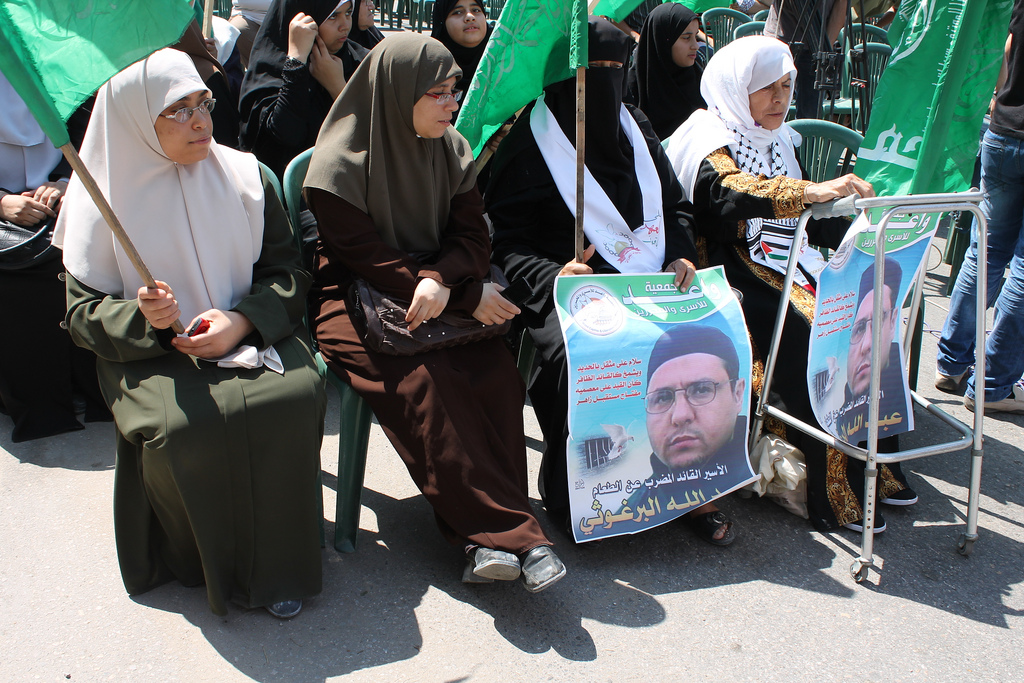
Abdullah Barghouthi, one of the five Palestinian prisoners with Jordanian citizenship on strike, is continuing to suffer from severe medical effects of his strike. His heartbeat is irregular, his vision is impaired, and he is continuing to suffer kidney and liver problems. His four fellow strikers with Jordanian citizenship, Mohammad Rimawi, Muneer Mar’i, Alaa Hammad and Hamza Othman Al-Dabbas, are now in what has been labelled the psychiatric ward at Ramle prison clinic, where they are even more isolated than before. All have been on hunger strike for 75 days and are shackled hand and foot to their hospital beds. They are also shackled hand and foot for legal visits despite their poor health. They are under 24-hour camera surveillance, yet requests for water can take up to an hour to fulfill.

The family of Ayman and Mohammad Al-Tabeesh, who have been on strike for 54 and 36 days, respectively, called for greater Palestinian, Arab and international advocacy for the prisoners whose lives are on the line in Israeli occupation prisons. Ayman is an administrative detainee demanding his freedom, and Mohammad is a former administrative detainee now serving an 18-month sentence. Mohammad launched his own strike in solidarity with his brother.

The 13 strikers currently on hunger strike are as follows:


Palestinian prisoner’s name

Date of Hunger Strike

Ayman Issa Hamdan 04/28/2013
Muneer Mari 05/02/2013
Abdullah Barghouti 05/02/2013
Alaa Hammad 05/02/2013
Mohammad Rimawi 05/02/2013
Hamza Othman Al-Dabbas 05/02/2013
Imad Batran 05/07/2013
Adel Hareebat 05/23/2013
Ayman Al-Tabeesh 05/23/2013
Hossam Mattar 06/01/2013
Mohammed Al-Tabeesh 06/12/2013
Eyad Abu Khudair 06/17/2013
Abdul Majed Khuderat 07/01/2013


Take Action: 75 days of strike. Abdullah Barghouthi in health crisis. Implement the demands of Jordanian hunger strikers!

abdullahbarghouthiFive Palestinian political prisoners with Jordanian nationality being held in Israeli prisons are entering their 75th day of hunger strike, and facing a severe health crisis. Take action today to join in their demands for justice.

Click to Tweet Now: ACT NOW: Abdullah Barghouthi and Jordanian hunger strikers in health crisis on 75th day of strike. Demand justice: http://wp.me/p2cx3f-Hu 

Abdullah Barghouthi, Mohammad Rimawi, Muneer Mar’i, Alaa Hammad, and Hamza Othman al-Dabbas launched their hunger strike on May 2, 2013. All carry Jordanian citizenship, and together issued three demands:

1. That they be released from Israeli prisons and serve their sentences in Jordanian prisons according to the Wadi Araba Agreement between Jordan and Israel. This agreement was previously applied to the case of prisoner Sultan Al-Ajouli, who was transferred to Jordanian custody in accordance with the agreement.

2. That the Occupation disclose the whereabouts of missing Jordanian prisoners, of which there are 20.

3. That the Occupation remove martyrs from the ‘numbered graves’, where prisoners who died in custody are currently kept in nameless graves.

 Their health has worsened progressively. Abdullah Barghouthi is currently held in Afula hospital, while Rimawi, Mar’i, Hammad and Othman al-Dabbas are held in the Ramle prison clinic. All are shackled, hand and foot, to their hospital beds. Abdullah Barghouthi has been physically assaulted on multiple occasions by his jailers, and is now in a severe health crisis.

He is no longer able to receive injections in his arms due to inflammation, and is taking only water. He is suffering from kidney, liver and other diseases, reported lawyer Jawad Boulos on July 13. These reports followed updates on July 10 that Barghouthi was suffering severe inflammations throughout his body. The Palestinian Prisoners’ Society also released a statement in which Barghouthi said “his hunger strike would end only on or under the Jordanian soil.” Barghouthi has been consistently suffering severe headaches and shivering throughout his body.

Hunger striking prisoners Muneer Mar’i, Mohammad Rimawi, and Ala’a Hammad were transferred to the Ramle prison clinic from Soroka Hospital on July 14. Hamza Othman al-Dabbas remained at Ramle clinic. Each of the prisoners have lost over 18 kilograms of weight and must use wheelchairs to move. Rimawi is being denied critical medicine for his heart disease because he refuses to end his hunger strike.

The families of the hunger strikers have called for action. Protests have taken place in London, throughout all areas of occupied Palestine, including ’48 Palestine, Ramallah, Gaza, and Nablus; and over 70 protests in Jordan. Take action today:

nnmTAKE ACTION!

1. Sign a letter demanding the Israeli state immediately implement the demands of the Jordanian hunger strikers. Tell the Israeli Prison Services that the world is watching! Click here to sign..

2. Join a protest or demonstration outside an Israeli consulate for Palestinian prisoners. Join one or announce your own. Organizing an event, action or forum on Palestinian prisoners on your city or campus? Use this form to contact us and we will post the event widely. If you need suggestions, materials or speakers for your event, please contact us at samidoun@samidoun.net. 

3. Contact your government officials and demand an end to international silence and complicity with the repression of Palestinian political prisoners. In Canada, Call the office of John Baird, Foreign Minister, and demand an end to Canadian support for Israel and justice for Palestinian prisoners, at : 613-990-7720; Email: bairdj@parl.gc.ca. In the US, call the office of Elizabeth Jones, Acting Assistant Secretary of State for Near East Affairs (1.202.647.7209). Demand that Elizabeth Jones bring this issue urgently to his counterparts in Israel.


Samer al-Barq enters fourth year in administrative detention without charge or trial

Samer al-Barq is entering his fourth year in administrative detention, without charge or trial, said the Palestinian Prisoners Study Centre.

Al-Barq was transferred from Jordanian captivity to occupation forces at the Karama crossing on July 11, 2010, and immediately placed under administrative detention without charge, said Amina Tawil of the Centre. She said that he engaged in several hunger strikes demanding his release, for 30 days, 125 days, and 43 days. He was repeatedly promised that a deal would be arranged in which he would be deported to Egypt from which he would return to Pakistan, the country of his wife’s citizenship, but these promises were never fulfilled.

He suffered severe medical consequences of his hunger strike, dropping in weight from 93 to 72 kilograms, suffering kidney disease, high blood pressure and low blood sugar. His administrative detention was renewed again in late June for another six months.

Samer al-Barq’s story in many ways captures the transnational security alliances of the US and its allies. He was arrested in Pakistan and held for three months in a secret US detention facility in 2003, from which he was transferred to Jordan. He was held by Jordanian intelligence for four years and then released in January 28. He worked at a medical laboratory, and his wife travelled from Pakistan to join him. He was then re-arrested by Jordanian secret services and transferred to the Israelis. At no point has he been charged with or tried for any crime. During his imprisonment without charge or trial he has been interrogated by the US Federal Bureau of Investigation, among others.

Thaer Halahleh moved to Ramle prison clinic following health crisis

thaerhalahlehPalestinian political prisoner and former hunger striker Thaer Halahleh has been transferred from Ofer prison to Ramla prison clinic following further deterioration in his health conditions, as he suffers from Hepatitis C, which he was infected with during a dental operation at Askelan Occupation prison.

Halahleh, who was released last June after a 77-day hunger strike conducted with fellow administrative detainee Bilal Diab, was re-arrested in April. Once again he has not been charged; Halahleh has been arrested eight times and served six and one half years in Israeli Occupation prisons. He has never been charged with a crime or tried; at all times he has been held without charges or under administrative detention.

Totah and Abu Arafah barred from Jerusalem, sentenced to 30 months in Israeli prison

totah-abuarafahTwo Palestinian legislators, Mohammed Totah and former minister Khaled Abu Arafah were sentenced on July 11 to 30 months in occupation prisons and deported from Jerusalem, their home city. Both were arrested on January 23, 2012 at their sit-in at the International Committee of the Red Cross in Jerusalem.

Like previous Palestinian parliamentarians Ahmed Attoun and Mohammad Abu Teir, Totah and Abu Arafah were barred from entering Jerusalem and threatened with six months in Israeli prisons if they enter their own city.

The elected officials took refuge at the Red Cross building in East Jerusalem’s Sheikh Jarrah in July 2010 along with lawmaker Ahmad Attoun after Israel revoked their residency permits.

Former prisoner al-Taj to go to Austria for medical treatment

altajMa’an reported on July 13 that a medical center in Austria has agreed to treat freed prisoner Mohamad al-Taj. Al-Taj, who suffers from pulmonary fibrosis and heart hypertrophy, is a former prisoner who was released from Israeli prisons in April, following two hunger strikes, due to his poor health.

He was released shortly after the death of Maysara Abuhamdieh, who suffered from cancer and who died in Israeli custody, chained to his hospital bed, after being denied treatment for a lengthy period of time.

Al-Taj had launched a hunger strike on July 7, demanding the Palestinian Authority take action to support his needed healthcare. His medical records were sent to Europe in May, and he hoped a country would offer him a lung transplant. He told Ma’an that the minister of detainees received approval for him to be treated in a Vienna medical center.

He will be initially treated with medication then according to his body’s response the doctors will determine if a transplant is needed. His treatment will be funded by the Palestinian Authority, which will transfer the expenses to the medical center, he added.


Israel lifts publication ban on the kidnapping of Wael abu Rida from Egypt

wael-aburidaIsraeli media reported on Wednesday, July 10, that Wael Abu Rida, a Palestinian from Gaza, was kidnapped by Israeli Mossad agents from Egypt, in the Sinai, a case first reported by Palestinian media on June 23, reaching international press on June 30. It was not until July 10, however, that an Israeli judge cleared news of the kidnapping for publication.

At the same time, the court extended Abu Rida’s detention for eight days. Judge Yuval Livadaro allowed the publication of some details in Israeli media, but extended the gag order of other details by 10 days.

The detainee’s wife, Amani Abu Rida, had reported to Ma’an that her husband disappeared during a visit to Egypt for medical treatment. The couple traveled together to Egypt on June 6. Wael Abu Rida suffers cerebral atrophy and sought treatment at a hospital in central Sinai, his wife said.

On June 21, Wael received a phone call and left without returning, his wife said.

The family later received a phone call from the International Committee of the Red Cross informing them that Wael was in Israeli custody, without giving any reason for the arrest. After the phone call, Amani returned to the Gaza Strip.


Former political prisoner Khader Adnan expresses solidarity with California hunger strikers

adnanstrikeSheikh Khader Adnan is a former Palestinian Political Prisoner and hunger striker whose protest about being detained without charge attracted worldwide attention. He refused food for 66 days and was freed earlier this year. Below is his message, from Addameer:

The policy of isolation is a cheap weapon in the hands of those who hold power. The policy of isolation is used against American citizens who are victims of the political, economic and social order/system that thrives on greed, discrimination and the deprived, including the African-Americans and  Palestinian resistors such as Sameeh Hamoudeh and Sami Al-Aryan.

The policy of isolation exposes the ugly face of these false democracies that are guilty of occupation, tyranny and social repression.

Hunger strikes are a courageous step and a real tool for all those who are deprived of their rights to lift the existing oppression, and I hope that these prisoners will gain their rights and their demands. Today, the hunger strikes of the Palestinian prisoners inspires those who are detained to engage in hunger strikes to guarantee that they are treated humanely and with respect and dignity.

I am a former administrative detainee in the Israeli Occupations’ prisons, who has been subjected to the unjust isolation policy. I fought in a hunger strike for 66 consecutive days against the policy of administrative detention, my detention without charge or trial. I announce my full solidarity with my oppressed brothers in the American prisons and I ask that the American people and government end the policy of isolation of the detainees and prisoners, and comply by human rights law that forbids continuous isolation because of its destructive effects on the mental and physical health of detainees.